The Index Reality Check: What Passive Investors Actually Own
Buy an index fund and the pitch says you own the market. What you actually own is a list of companies ranked by size, where the top of the list decides most of your result and the bottom is close to decoration.
None of this makes indexing a mistake. It makes indexing a specific bet, and most people who hold it have never looked at the terms.
This hub walks through what a passive portfolio really contains: the weighting math, the concentration it produces, the costs on and off the label, and what you give up in exchange. Each section links to a deeper article in this series.
How a cap-weighted index fund allocates your money
An index fund does not spread your money evenly across its holdings. It copies the index, and most major indexes weight each company by market capitalization: share price times shares outstanding.
The consequence is simple and underappreciated. The bigger a company already is, the more of your money the fund routes into it, automatically and without judgment.
Take a hypothetical five-stock index. The market caps are $3.0 trillion, $2.0 trillion, $1.0 trillion, $500 billion, and $500 billion, for a total of $7.0 trillion.
| Company | Market cap | Index weight | Share of a $10,000 investment |
|---|---|---|---|
| A | $3.0T | 42.9% | $4,290 |
| B | $2.0T | 28.6% | $2,860 |
| C | $1.0T | 14.3% | $1,430 |
| D | $0.5T | 7.1% | $710 |
| E | $0.5T | 7.1% | $710 |
Two companies out of five absorb $7,150 of the $10,000. That is not a flaw in the fund: it is the design, and it scales up to real indexes with 500 names.
There is a second quiet assumption in “owning the market.” A large-cap index is not the economy: it excludes private companies entirely and leaves small caps to separate benchmarks like the Russell 2000.
So the standard passive portfolio is a size-weighted slice of the largest public companies. That can be exactly what you want, as long as you chose it rather than assumed it.
What concentration looks like inside a real portfolio
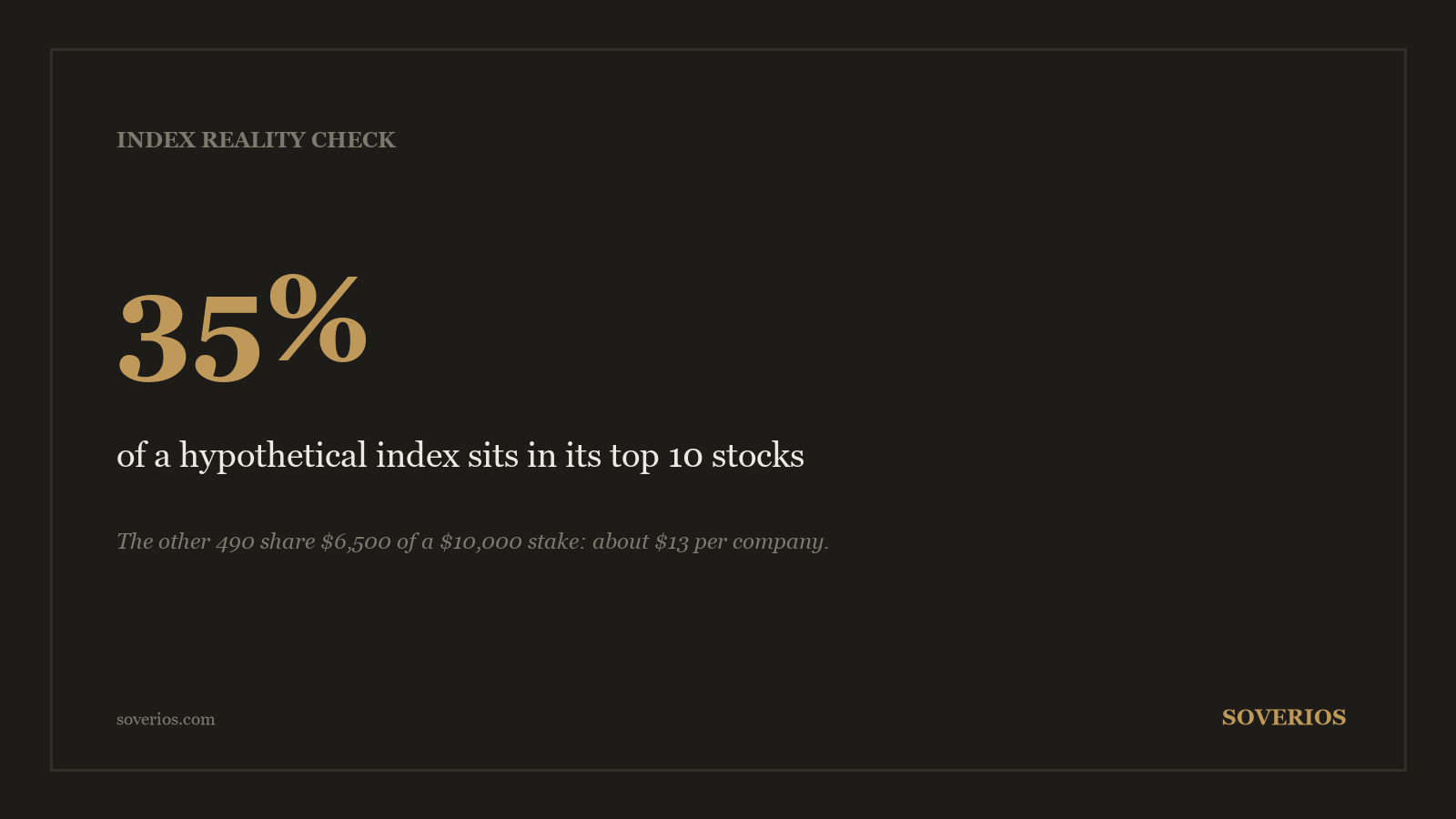
Scale the same math to a broad index and the pattern holds. Suppose the top 10 stocks of a 500-stock index carry 35 percent of the weight, a level of concentration in the range major US indexes have reached in recent years.
A $10,000 investment then places $3,500 into 10 companies. The other 490 companies split $6,500, which averages about $13 each.
At $13 a position, even a stock that triples adds roughly $26 to your portfolio. The small holdings exist, but they cannot move the needle: your outcome is effectively decided by the giants.
The mechanics behind this, and why the index keeps drifting toward its largest names, are covered in the hidden concentration of the S&P 500. Whether concentration is actually a problem, or a mathematically defensible choice, is a separate question we work through in the math of concentration versus diversification.
One number makes the risk concrete. If a single stock carries a 7 percent index weight and falls 30 percent, that one move subtracts 2.1 percentage points from the whole index, no matter what the other 499 companies do.
Is a passive portfolio really passive?
“Passive” suggests nobody makes decisions, but somebody does. An index committee decides which companies enter, which ones leave, and how the rules bend in edge cases, and every fund tracking the index inherits those calls.
Additions and deletions are not neutral events for your money either. A stock typically joins a major index after its market cap has already grown large, which means index investors systematically buy companies after their biggest run, at the weight their new size commands.
The reverse holds on the way out. Companies usually leave an index after a long decline, so the fund sells low what it bought high, by rule rather than by judgment.
None of this is scandalous, and turnover in broad indexes stays modest. But it is worth retiring the idea that an index portfolio involves no active choices: the choices are simply outsourced to a methodology document most holders never read.
The costs you see and the costs you never see
The visible cost of indexing is the expense ratio, and it has never been lower: a few basis points buys you the market. But small percentages compound into real dollars over decades, a calculation we run in full in what expense ratios really cost you over 20 years.
The less visible cost is the gap between what the index returned and what your fund returned. That gap, called tracking difference, includes the expense ratio plus trading costs, cash drag, and sampling choices, and it is only measurable after the fact.
A fund can advertise a 0.03 percent fee and still lag its index by more than that every year. How to measure this before you buy is the subject of tracking difference: the index fund fee you never see.
One rough number frames the stakes. On a hypothetical $100,000 compounding for 20 years, an index at 8.0 percent per year grows to $466,096, while the same money at 7.75 percent, just 0.25 points lower, reaches $444,985: a $21,111 gap from a cost too small to notice on any statement.
What passive investors give up
Indexing guarantees the market return minus costs. The same contract guarantees you will never beat the market, because you own everything: the compounders and the value destroyers, at whatever weight their size dictates.
A cap-weighted fund holds every overpriced stock in proportion to its overpricing. It cannot skip a company with deteriorating economics, and it cannot add to a great business when the price is briefly attractive.
There is also no lever for income. The fund pays out whatever dividend yield the weighted index happens to produce, while an investor building an income portfolio deliberately, along the lines of the stock picker’s guide to dividend investing, chooses that number.
The full argument, including what a disciplined picker can realistically exploit, is laid out in what ETF investors give up: the case for picking stocks. The honest counterpart, what it actually takes to beat the market and why most people fail, is covered in beating the market: what it actually takes.
Selection is the whole game for a stock picker. That work starts with a repeatable process, like the one in how to analyze a stock, and with metrics that resist accounting cosmetics, like free cash flow.
The honest case for indexing
A reality check has to run in both directions. Index funds deliver the market return at a cost close to zero, and the majority of professional active managers have historically failed to beat their benchmark after fees over long periods.
An ETF wrapper adds intraday liquidity and, in the US, meaningful tax efficiency for buy-and-hold investors. For someone unwilling to read financial statements, a broad index fund remains one of the best default options available.
The critique in this series is not that indexing fails. It is that “passive” is marketed as neutral when it is a concentrated, momentum-following, size-weighted strategy, and that investors deserve to know it.
| What indexing promises | What the fine print says |
|---|---|
| Own the whole market | Own it weighted by size: a few giants dominate |
| Instant diversification | Hundreds of names, but returns driven by the top 10 |
| Nearly free | Expense ratio plus a tracking gap you must measure yourself |
| Match the market | Match it minus costs, and never beat it |
Where to go from here
Start by finding out what you actually hold. Open your index fund’s latest holdings report, add up the weight of the top 10 positions, and translate that percentage into the dollars of your own account.
Then price the ownership honestly: compare your fund’s 5-year return against its index to estimate the real annual cost, not the advertised one. The articles in this pillar give you the method for each step.
If the concentration and the constraints sit well with you, indexing remains a rational choice. If they do not, the alternative is not day trading: it is diversification on your own terms, through a small number of businesses you have analyzed and can defend.
Frequently asked questions
Do index fund investors really own all 500 stocks in the S&P 500?
Yes, through the fund they hold a proportional slice of every constituent. But cap weighting means the exposure is heavily tilted: the largest names drive most of the return, while the smallest holdings are too small to matter individually.
Is a broad index fund automatically diversified?
It holds hundreds of names, which protects against any single bankruptcy. But when a handful of mega-cap stocks dominate the weight, the portfolio's day-to-day behavior tracks those few companies more than the other hundreds combined.
Are index funds a bad investment?
No. They deliver the market return at very low cost, which most active funds fail to beat after fees. The point is to know exactly what you own: a size-weighted bet on the largest companies, not an equal claim on the whole economy.
What costs do index investors pay beyond the expense ratio?
Tracking difference captures the real gap between the fund and its index. It includes the expense ratio plus trading costs, cash drag, and sampling effects, partly offset by securities lending income. It can only be measured after the fact.
Educational content only, not investment advice. See our methodology and disclaimer.
Sources: www.investor.gov · www.investor.gov · www.investor.gov