The Hidden Concentration of the S&P 500
The S&P 500 is sold as broad exposure to 500 leading US companies. Broad it is, but not balanced: the index weights every constituent by market capitalization, and that single design choice concentrates your money in a handful of giants.
This is not a hidden defect someone should fix. It is the published methodology working exactly as intended, and every investor in an S&P 500 fund should be able to do the math behind it.
How cap weighting concentrates the index
A cap-weighted index assigns each company a weight equal to its market value divided by the market value of all constituents combined. Size in, weight out, no other judgment applied.
Watch what that does in a hypothetical five-stock index worth $7.0 trillion in total.
| Company | Market cap | Weight |
|---|---|---|
| A | $3.5T | 50.0% |
| B | $1.5T | 21.4% |
| C | $0.8T | 11.4% |
| D | $0.7T | 10.0% |
| E | $0.5T | 7.1% |
Company A is half the index by itself. An investor who buys this “diversified” five-stock fund has made, above all, a bet on Company A.
The S&P 500 runs the same formula across 500 names, with one refinement: weights use free float, the shares actually available to public investors. Float adjustment trims companies with large insider stakes, but it does nothing to limit how heavy the top can get.
Why the concentration keeps growing
Cap weighting has a built-in feedback loop. When a stock outperforms the rest of the index, its market cap grows faster, so its weight rises, so it drives even more of the next period’s return.
No one at an index fund decides this. There is no valuation review, no trimming rule, no ceiling: the index holds more of whatever has already gone up, for as long as it keeps going up.
Compare that with an equal-weight version of the same 500 stocks. There, every company gets 0.2 percent, and quarterly rebalancing forces the fund to trim winners and add to laggards, the opposite behavior.
The two designs produce genuinely different portfolios from identical ingredients. Which trade-off wins, and when, is the subject of the math of concentration versus diversification.
What index concentration means in dollars
Percentages hide the stakes, so translate them. Suppose the top 10 stocks of a 500-stock cap-weighted index carry 35 percent of the weight, a level in the range major US indexes have reached in recent years.
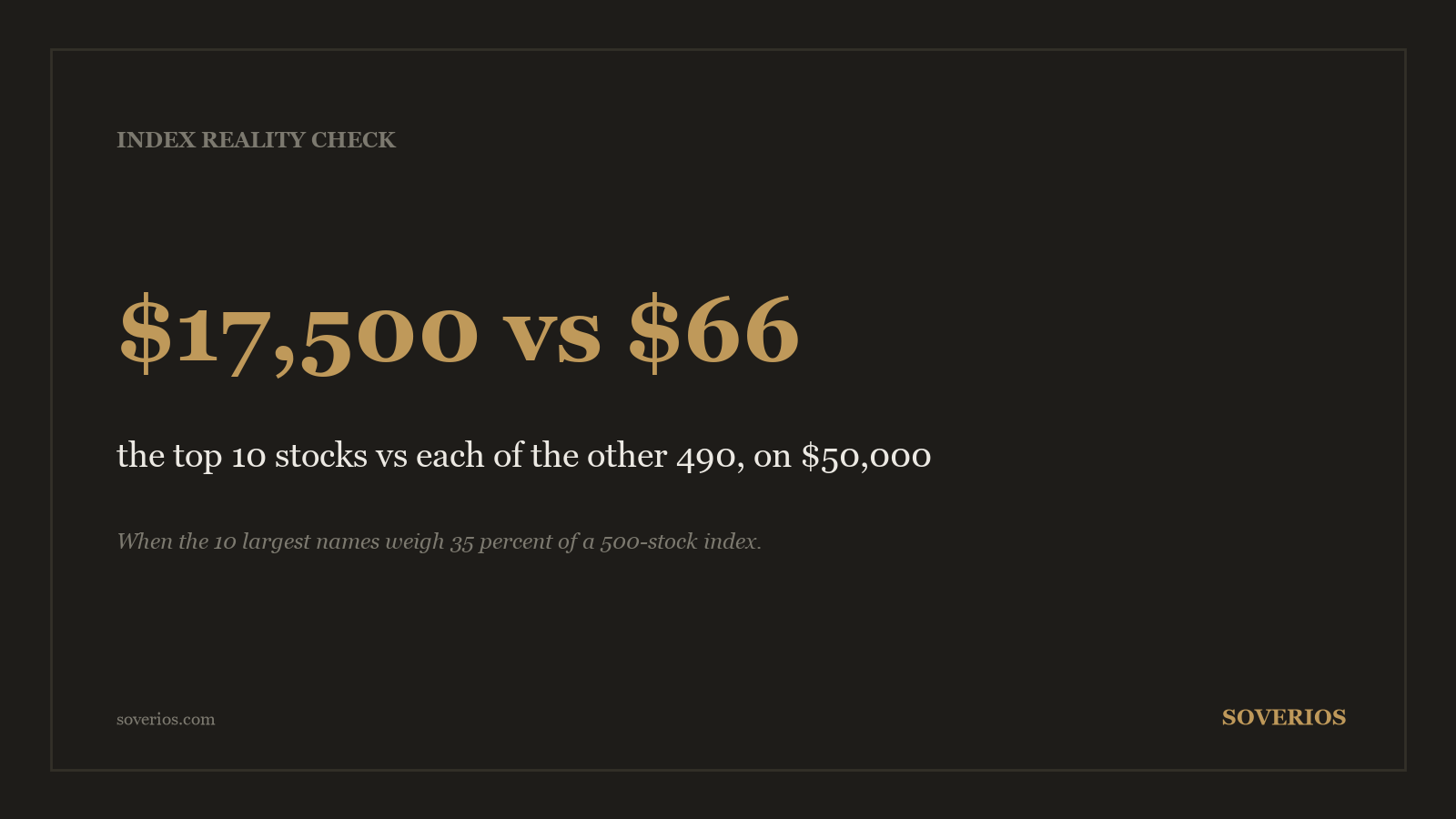
An investor with $50,000 in that index fund holds $17,500 across 10 companies. The other 490 companies share the remaining $32,500, an average of about $66 each.
| Slice of the hypothetical index | Weight | Dollars of a $50,000 position |
|---|---|---|
| Top 10 stocks | 35% | $17,500 |
| Other 490 stocks | 65% | $32,500 (about $66 each) |
| Smallest 100 stocks (if 1.5% combined) | 1.5% | $750 (about $7.50 each) |
Look at the bottom row. If the smallest 100 constituents carry a combined 1.5 percent weight, they represent $750 of the position, about $7.50 per company.
Those 100 businesses could collectively double and add $750 to a $50,000 portfolio. The investor owns 500 stocks on paper and about 30 that matter in practice.
The downside math nobody runs
Concentration cuts hardest in reverse, and the arithmetic is short. A stock with a 7 percent index weight that drops 30 percent subtracts 2.1 percentage points from the index by itself.
Now let the top 10, at a combined 35 percent, fall 20 percent together while the other 490 stocks stay flat. The index loses 7 percent, and no amount of strength in the remaining 465 dollars-per-stock positions can offset it.
Mega-cap stocks do fall together more often than a correlation-free model would predict. They share exposures: the same buyers, the same index flows, and in recent cycles the same handful of themes.
How to measure concentration yourself
The cleanest single measure is the effective number of holdings: square each weight, add the squares, and take the inverse of the sum. It answers the question “how many equally weighted stocks would behave like this portfolio?”
Run it on the five-stock index from earlier. The squared weights are 0.2500, 0.0458, 0.0130, 0.0100, and 0.0050, which sum to 0.3238, and the inverse is about 3.1.
Five names on paper, three in practice: that is what the metric makes visible. An equal-weight index of 500 stocks scores exactly 500, because 500 squared weights of 0.002 sum to 0.002 and the inverse is 500.
| Portfolio | Holdings on paper | Effective holdings |
|---|---|---|
| Hypothetical 5-stock cap-weighted index | 5 | About 3.1 |
| Equal-weight 500-stock index | 500 | 500 |
A cap-weighted 500-stock index lands somewhere far below 500 on this scale, and the heavier the top 10, the lower the score falls. If you can export your fund’s weights to a spreadsheet, the whole calculation is one column of squares and one division.
Narrower indexes push the same math further
Everything above applies with more force to narrower cap-weighted benchmarks. The Nasdaq-100 draws from about 100 non-financial companies, so the same weighting formula spread over fewer names concentrates the top even more.
Stacking a broad index fund with a Nasdaq-100 fund, a common portfolio pattern, does not diversify much either. The largest constituents of the second fund are largely the largest constituents of the first, bought twice.
What a stock picker does with this
The index reality is the starting point of this whole pillar: passive investors hold a size-weighted portfolio whether it suits them or not, as we detail in the index reality check. A stock picker’s real edge here is not omniscience, it is control of position sizing.
Picking your own holdings means deciding that no position exceeds, say, 10 percent of your portfolio, or deliberately concentrating in your best ideas with full knowledge of the math. Either way the weights reflect a decision, not a formula, which is a core part of the case for picking stocks.
Three concrete steps apply this article. First, pull your index fund’s holdings report and sum the top 10 weights, then multiply by your account balance to see the concentration in dollars.
Second, check how much of your other funds overlap with those same 10 names. Third, if you hold individual stocks, apply the 7-percent-weight stress test to your own portfolio: a 30 percent drop in your largest position should be survivable, because diversification you have not stress-tested is a guess.
Frequently asked questions
Why is the S&P 500 so concentrated in a few companies?
Because it weights companies by float-adjusted market capitalization. The formula assigns weight in proportion to size, so a handful of multi-trillion-dollar companies mechanically outweigh hundreds of smaller constituents. Nothing in the methodology caps how large a single weight can grow.
Does owning 500 stocks mean I am diversified?
Partially. You are protected against any single company going to zero, but not against the top of the index moving together. When 10 stocks carry a third of the weight, their correlated drawdown moves your whole position.
Is index concentration always bad for returns?
No. When the largest companies keep outperforming, concentration amplifies gains, and cap-weighted indexes ride their winners without selling them. The cost shows up in reverse: the same math amplifies the damage when the leaders fall together.
What is float adjustment in the S&P 500?
The index counts only shares available for public trading, excluding insider and strategic holdings. A company with a large founder stake therefore weighs less than its full market cap suggests. It refines the weights but does not reduce concentration at the top.
Educational content only, not investment advice. See our methodology and disclaimer.
Sources: www.investor.gov · www.investor.gov