What ETF Investors Give Up: The Case for Picking Stocks
Buying a broad index fund is a package deal. You get the market’s return at a fee close to zero, instant diversification, and strong tax efficiency, which is why the SEC describes the ETF structure as one of the cheapest ways to hold a basket of securities.
What the package removes is every form of judgment. No view on price, no view on quality, no right to refuse a business you would never buy on its own.
This is the trade at the center of our index reality check. This article prices what the index investor hands over, and states honestly what the stock picker must supply to earn it back.
You give up any opinion on price
A cap-weighted index fund sizes every position by market capitalization. The mechanical consequence: the more a stock has already risen, the more of your next dollar it absorbs.
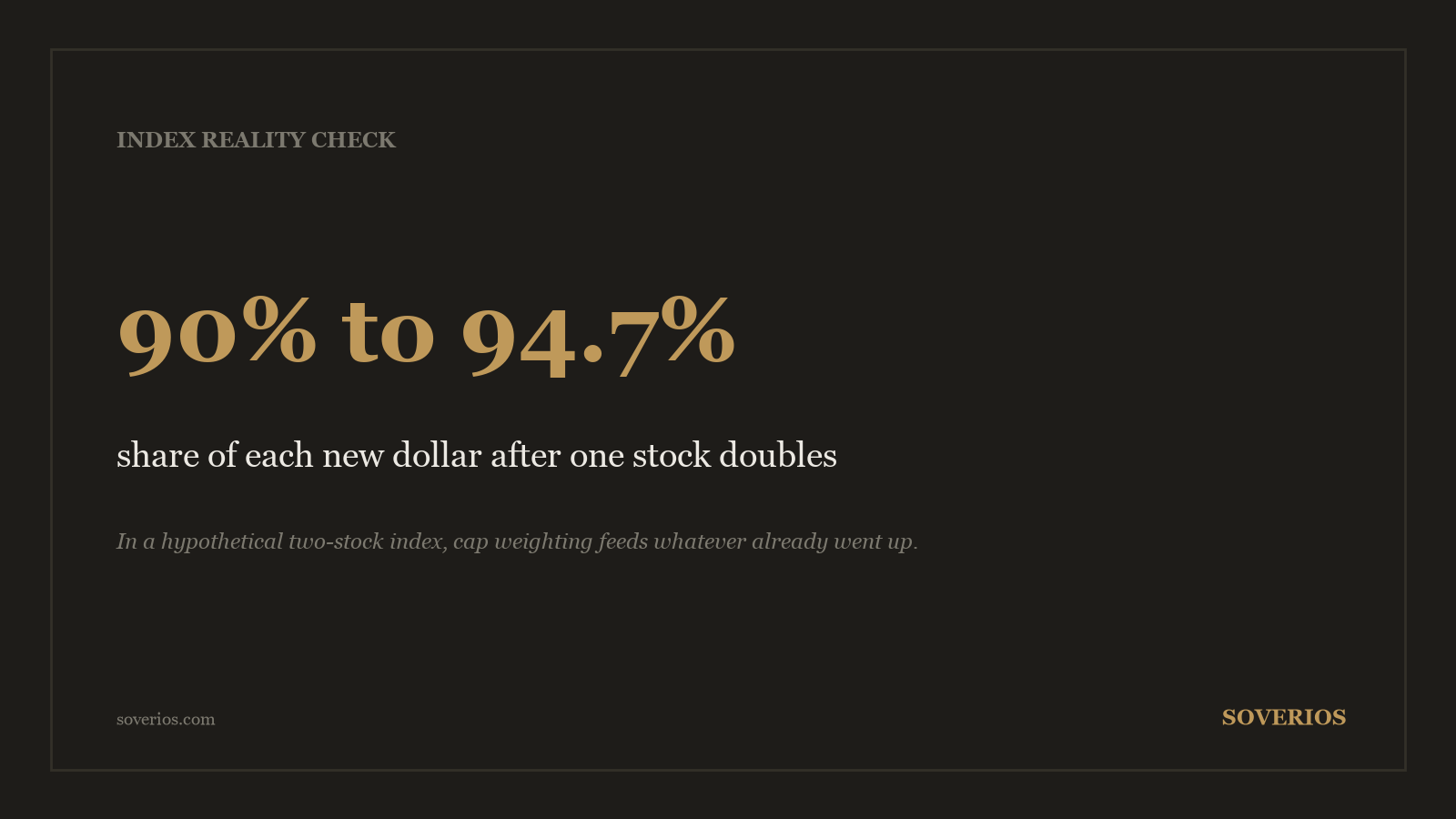
A hypothetical index makes it concrete. Suppose it holds two stocks, A at $900 billion of market cap and B at $100 billion, so a new dollar splits 90 cents to A and 10 cents to B.
Now A doubles while B stays flat. The index holds $1,800 billion of A against $100 billion of B, and every new dollar now sends about 94.7 cents to the stock that just doubled.
| Moment | Weight of stock A | Weight of stock B |
|---|---|---|
| Before A doubles | 90.0% | 10.0% |
| After A doubles | 94.7% | 5.3% |
Nothing in that shift involved a judgment that A was worth more. Price went up, therefore weight went up, whatever the relationship between price and intrinsic value.
The result today is a benchmark where a handful of names dominate, as the numbers in the hidden concentration of the S&P 500 show. Index buyers hold that concentration without having chosen it.
You give up the right of refusal
Own the whole index and you own every business in it: the ones gaining share and the ones losing it, the ones with an economic moat and the ones being commoditized, the conservatively financed and the heavily indebted.
A stock picker’s cheapest edge is subtraction. Declining to own a structurally challenged business requires no forecast, only the discipline to read the filings, spot the pattern, and pass.
The index investor cannot pass. Every deteriorating balance sheet in the benchmark rides along at its market weight until the index committee removes it, which typically happens after the decline, not before.
You give up meaningful position sizes in your best ideas
Even when an index holds a great business, it usually holds it at a weight too small to matter. Suppose a stock returns 10x over a decade: in an equal-weight portfolio of 20 stocks, that single winner adds 45% to the whole portfolio.
Diluted across hundreds of index positions at a fraction of a percent each, the same 10x barely moves the needle. The full arithmetic of that dilution, and its mirror image on the downside, is worked through in the math of concentration vs diversification.
Concentration is not free: it amplifies mistakes with exactly the same force. That symmetry is the honest core of the choice, not a detail of it.
You accept a ceiling, and it is lower than the index
By construction, the index investor’s return is the market’s return minus costs. The market return is the ceiling, and no amount of patience raises it.
The costs are small but real. The expense ratio compounds against you for decades, as the 20-year tables in what expense ratios really cost show, and tracking slippage adds a second, quieter leak covered in tracking difference.
So the honest statement of the deal is this: guaranteed average, minus a little. For money you cannot afford to manage badly, that is a strong offer.
What the ceiling and the floor are worth in dollars
The stakes of that ceiling become concrete over a full investing horizon. Suppose a hypothetical market compounds at 7% a year for 20 years, turning $100,000 into $386,968 before costs.
A picker who beats that by two points a year, at 9%, ends with $560,441. One who trails by two points, at 5%, ends with $265,330.
| Annual return over 20 years | Final value of $100,000 |
|---|---|
| 9% (market + 2 points) | $560,441 |
| 7% (the market) | $386,968 |
| 5% (market - 2 points) | $265,330 |
The index investor locks in the middle row, minus fees, and refuses both of the others. The whole debate about picking stocks is whether your process can make the top row more likely than the bottom one.
You give up knowing what you own
There is a quieter forfeit: the index buyer typically cannot name 20 of the hundreds of businesses in the fund, let alone their debt loads or margins. Exposure without knowledge is the default state of passive ownership.
That matters at the worst moments. An investor who knows exactly what each holding earns has a reason to hold through a 30% drawdown, while an investor holding an anonymous basket has only faith that the average recovers.
Fund structure adds a final layer: proxy votes for every company in the basket are cast by the fund manager. The economic exposure is yours, but the shareholder’s voice is not.
The honest counterargument: most pros lose this bet
Any case for stock picking has to face the record. Long-running scorecards comparing active funds with their benchmarks, including S&P Global’s SPIVA series, have shown for years that most professional managers trail the index over long horizons, especially after fees.
Picking stocks does not fail because markets are perfectly efficient. It mostly fails because it is done casually: too many positions, too little reading, no selling discipline, and fees or turnover eating the margin.
That is why the ceiling argument cuts both ways. The index guarantees average, and average beats the majority of people who try to do better, a point developed in beating the market: what it actually takes.
What the stock picker must supply
The give-ups above are only worth recovering if you replace the index’s discipline with a stricter one of your own. That starts with staying inside your circle of competence: businesses whose filings you can actually read and whose economics you can explain.
It continues with a repeatable process rather than a watchlist of hunches. A written framework like how to analyze a stock step by step and a hard filter like a 12-metric checklist exist precisely to remove improvisation.
And it ends with measurement. Track your results against the index fund you could have bought, after taxes and costs, and let three to five years of that comparison tell you whether the judgment you bought back is earning its keep.
The index will always be there at 0.03% if the answer is no. That exit is the one advantage the stock picker keeps for free.
Frequently asked questions
Can you beat the market with index funds?
No, and that is by design. A fund that holds the market at market weights earns the market's return minus its costs. The guarantee of never trailing the index badly is also a guarantee of never beating it.
Do ETF investors actually own the underlying stocks?
They own shares of a fund that is registered with the SEC and holds the stocks. Economic exposure passes through, but decisions like proxy voting are exercised by the fund manager, not by the end investor.
Is stock picking worth it for most investors?
For most people, honestly, no: it demands accounting literacy, a repeatable process, and hours per position. It becomes defensible when you treat it as work, restrict yourself to businesses you understand, and measure results against the index you could have bought.
What does cap-weighted mean?
Each stock's weight equals its market capitalization divided by the total for the index. The consequence is mechanical: whatever has grown largest takes the largest share of every dollar you invest, with no view on valuation.
Educational content only, not investment advice. See our methodology and disclaimer.
Sources: www.investor.gov